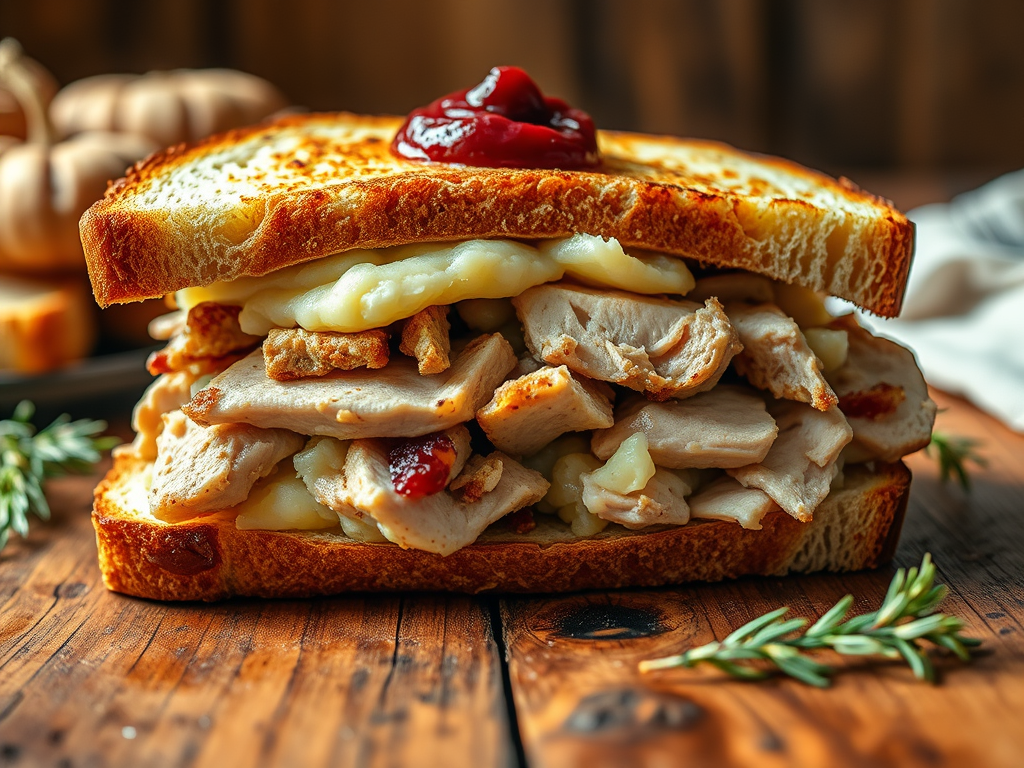
Last night I got to eat the perfect sandwich.
From the way it was put together1 to the first bite—and from the first to the last— it lit every lantern along the cold, dark way home; it kneaded every knot from my braced and twisted muscles; it bathed me in nostalgia, love, and, yes, hope. Forgive me if I’m overdoing it here, but my friend: if a mere sandwich can not only sate but warm, comfort, and uplift, think what we can do—or rather, what we already do—for one another in small ways all the time.
Every year before Thanksgiving, I run around like Mrs. Dalloway (we generally feed anywhere from twelve to twenty-three guests, all family and close friends) making sure there are enough coat hangers, napkins, plates, glasses, silverware, bottles of wine and alternative beverages, ice cubes, places to sit and converse, centerpieces, and so on. That’s my job; Michael does the cooking. All the cooking.
Regardless of the numbers expected, my nervous system reacts like we’re hosting a banquet for dignitaries or top-tier celebs and I’m the Majordomo. I obsess with the same intensity, the same sense of purpose I’d feel if Barack and Michelle or Dolly Parton or Robert Downey Jr. had told me they’d be stopping by. It’s not that I want to impress— I don’t care about that— but Michael and I both want everyone to feel welcome, at-home, well-cared-for, and to leave no one stranded in the loo with an empty cardboard roll and nowhere to turn.
I was never much of a girly-girl, and from childhood on was patently uninterested in being the perfect hostess or even in owning any dishes. Until my thirties, in fact, I never had the space to throw a party. I shared modest living quarters with fellow actors or some mix of students, musicians and dancers or other random roommates found through mutual acquaintances or classified ads. We’d gather, but in ways that were mutually understood to be college dorm-or opium den-casual: bring your own snack and beverage; no socks or shoes required; sit (or pass out) on the rug. Hosting does not come naturally to me. It’s a skill I acquired late in life.
Twenty-five or so years ago, I finally grasped that for me, theatre would never pay medical bills, provide financial security, secure a decent retirement, or allow me to be taken seriously in any social group consisting of adults who’d made more realistic professional choices: those with mortgages, children, automobiles, health insurance, and savings accounts2. It’s not about the house or the Roth; it’s not how much or what you have (I had things, too: a futon, a sleeping bag, several part-time jobs, debt, and a chronic stomach ache I couldn’t afford to have diagnosed or treated); it’s about quality of life. But money—by which I mean lack of it—had started to interfere with that.
I know many theatre professionals who did not take the same off-ramp I did and who have no regrets. Theatre is a practice of constant challenges, growth, and discovery, and in no other artistic pursuit does one make so many intimate, lifelong friends or learn so much about human history, literature, psychology, culture, and oneself; in no other pursuit does one co-create such beautiful, ephemeral stories for the delight and edification of others. Theatre gives you an astonishing skill set and is a proud career if you can sustain it. I could not.
I stopped auditioning, stopped writing grants. I went to graduate school, bought property, married a grown-up, and started a new career.
In what, 2008—coinciding with a move to a bigger home—I started truly appreciating the ritual aspects of holiday gatherings (even small talk, once a source of bemusement if not irritation, has important social functions, as I now know). I came to recognize and treasure that not only do Michael and I have friends who feel like family; we have family who feel like friends. I loved that we finally had a great room and guest rooms and a big, long table. I came to both dread and look forward to the holidays precisely because we could accommodate a throng. Things can go wrong—hosting is a risky business—but things can also go right. Children and grandchildren, nieces and nephews, parents and grandparents and other loved ones can sleep over; everyone can mingle, catch up, enjoy the food, play games, laugh with and at each other, and as it always happens, completely trash the place.
My evolution to the woman you see before you today—the one with the spray bottle and dust cloth in her hand; the one plumping cushions and moving that vase from the end table to a closet shelf so it doesn’t get knocked over and make someone feel bad when I totally should’ve foreseen how precariously it was situated—was not inevitable, but it was inexorable. I matured. I took on new domestic and familial responsibilities (some of them traditionally gendered; others not) and came to enjoy executing them. Some people get a charge out of pulling off a great meal (Michael); I, with my dramaturgical leanings, sometimes like staging an event; creating an inviting space to hang out in.
As Thanksgiving Day begins, I rise early. I attempt to human-proof the premises. For instance, I duct-tape the edges of tablecloths up under the table so an inattentive child or hapless older guest won’t stand to stretch or leave the table and accidentally pull the whole show down onto their lap. I happen to be preturnaturally3 attuned to potential catastrophe4 so I also tape socks to the casters on our dining room chairs lest my ninety-three-year-old parents innocently lower themselves to a chair and wind up on the floor. For my sock-taping method, which involves rubber bands, electrical tape, and Michael’s socks5 —backchannel me.
By ten a.m., I have turned my attention to affordances and conveniences. I run to the store multiple times, as every list I make leaves off something important, e.g., limes for drinks, seltzer, or band-aids in case someone needs one. No one ever has. Our after-dinner round of Spoons inevitably generates a lot of noise, but I am the only person who has ever come close to injuring herself: I propelled myself like Charles Woodson across the dining room table to intercept the last spoon before Milo got it (which I didn’t anyway, and I could have broken a rib).
During the meal, I cruise, checking to make sure everyone has what they want and need, picking up anything that has fallen to the floor that might be a slipping or tripping danger6, closing or opening windows if I see someone shivering or perspiring; adjusting my dad’s hearing aids while he is wearing them even if he didn’t ask me to—that sort of perfectly normal thing.
As a consequence of wandering around, I often eat only half of what I put on my plate. Then, I get distracted by bussing. I’m not saying I’m harried or hassled; I’m not. Our friends bake, bring, and cut the pies. They even whip the cream. Some Thanskgivings, I only wash or dry a few dishes because my brother or someone else takes that on. What I’m saying is, the occasion is lovely and collaborative, I just don’t eat much is all; I’m kind of on duty the whole time. I don’t have to be; I just am.
Later, when digestion has turned fullness to an incomprehensibly renewed interest in food—when it’s leftover time—rarely if ever do I jump in and claim bits of turkey for myself because either I’m not re-hungry when everyone else is, or I completely forget what a hot commodity it is. By the time I get around to thinking, I’d love me a day-after-Thanksgiving turkey sandwich, there is no turkey left. This has been true if not every year then at least mostly.
This year, I whined a little bit (off to the side, to Michael) and without telling me, he surreptitiously slid a couple of wings into a plastic container, which he hid in the back of the fridge, recovering it yesterday after we’d said our goodbyes to the family and found ourselves alone.
In a gesture so sweet it nearly brought me to tears, he managed to glean enough meat for a sandwich.
Unlike Ross Geller (with whom I know you are drawing comparisons) I don’t want lettuce or mayo on my sandwich, and I refuse to even say the m-word he uses to describe his secret ingredient. Me, I like white bread (toasted), turkey, stuffing, mashed potatoes and gravy, cranberry sauce, and a bit of onion.
OMG. Everything about it. I’m not saying it’s Proust’s madeleine; the sight of it, the scent, the taste triggered no childhood memories or seven volumes (only nineteen paragraphs) but it did make me feel like kittens and puppies inside; like sitting before a cozy fire on a winter’s day; like being seen and taken care of.
And then, the flood came: for that and for all things good; for my husband; for family and friends, and for all the people who help me and all of us get through our days. For first responders; for nurses, physical therapists, and doctors; for baristas and waiters; for the guys who keep our city streets repaired. For the people who repair roofs; the handymen and women who solve our problems big and small; the people who assume leadership roles and exercise their duties with insight, inspiration, and responsibility. For inventors, entertainers, and teachers. For the mothers and fathers; the siblings, aunts and uncles; the step parents and grandparents. For all good neighbors everywhere. For the plumbers and sanitary workers. For the security guard at the store we shop at. For the bartender and the stylist, and the organizers of community events. For all the invisible and visible kindnesses. For the joys and the pain. For our capacity to absorb loss and grief. For those we miss, those we know and love, and those we do not… the gratitude continues to pour forth.
Now that’s a good sandwich.
- With tender affection ↩︎
- That described nearly everyone my age, and I came to observe that a person is not de facto boring or dead inside merely because they’re conscientious and stable. ↩︎
- Some would say insanely ↩︎
- See my memoir, The End of the World Notwithstanding, for proof ↩︎
- Don’t mention that part to him, please ↩︎
- Did you know a simple grape can cause serious injuries? ↩︎

 Janna L. Goodwin